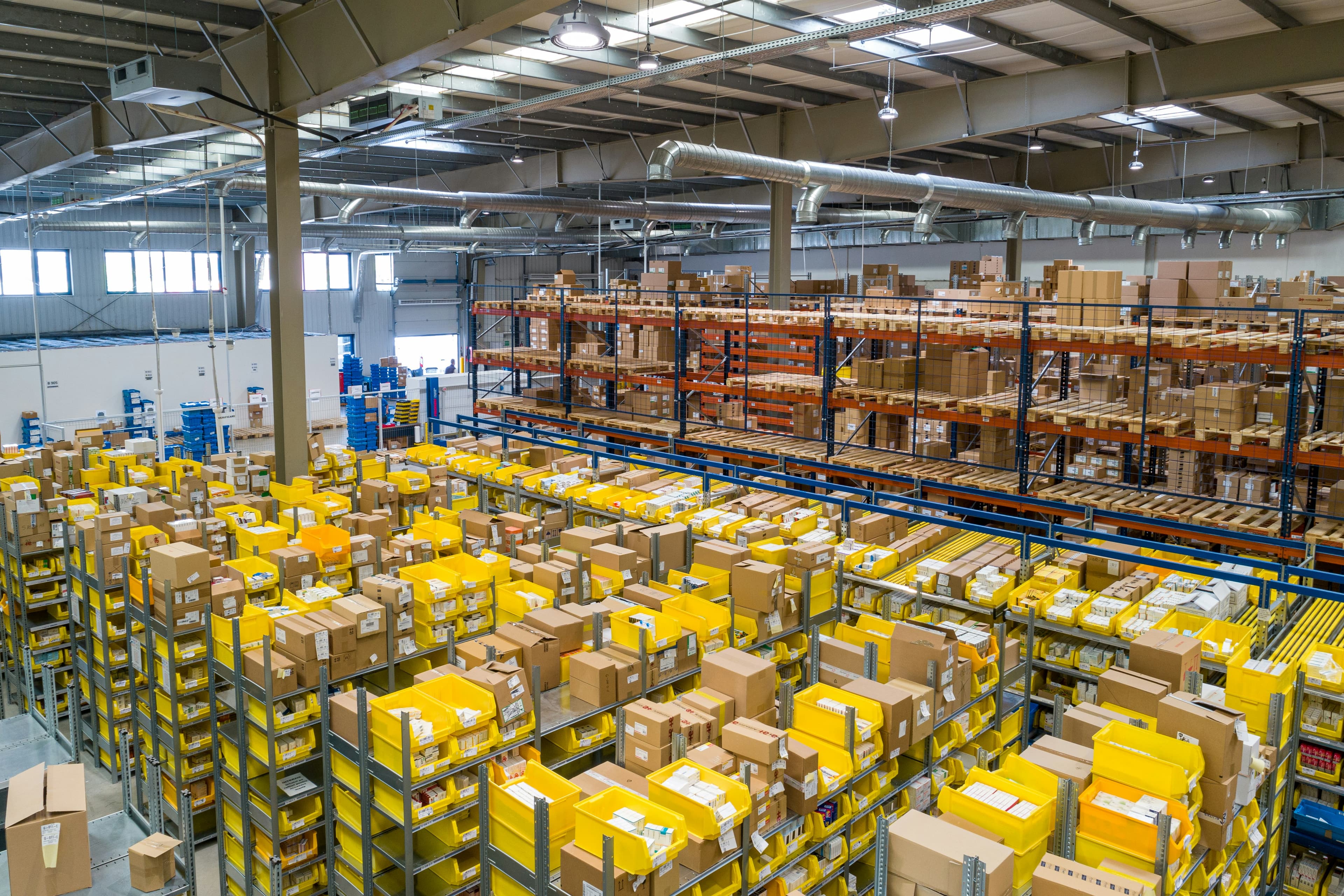
Why warehouse bottlenecks and reporting delays persist in wholesale distribution
Wholesale distributors operate on narrow margins, high order volumes, variable supplier performance, and constant pressure to ship accurately and quickly. In many organizations, warehouse slowdowns and delayed reporting are not isolated technology issues. They are symptoms of fragmented workflows across purchasing, receiving, inventory control, order management, transportation, finance, and customer service.
A wholesale ERP system reduces these issues by creating a shared operational record across warehouse and back-office processes. Instead of relying on spreadsheets, disconnected warehouse tools, manual status updates, and end-of-day reconciliations, teams work from synchronized inventory, order, and financial data. That improves execution on the floor and shortens the time required to produce reliable operational and executive reporting.
For distributors, the value of ERP is not just transaction processing. It is workflow standardization, exception visibility, and better coordination between physical movement of goods and the business rules that govern those movements. When implemented well, wholesale ERP helps reduce congestion in receiving, putaway, replenishment, picking, packing, shipping, and returns while also improving margin, fill rate, and inventory reporting.
Common operational causes of warehouse bottlenecks
- Inbound receipts arrive without accurate advance shipment data, forcing manual receiving and delayed putaway.
- Inventory locations are not updated in real time, causing pickers to search for stock or trigger avoidable replenishment tasks.
- Order prioritization is inconsistent across sales, customer service, and warehouse teams.
- Wave planning and labor allocation are based on static rules rather than current order mix and dock capacity.
- Returns, damaged goods, and quarantine inventory are handled outside the core system, reducing inventory accuracy.
- Finance closes and management reporting depend on manual reconciliations between warehouse activity and ERP transactions.
- Multiple systems define item masters, units of measure, lot controls, and customer-specific fulfillment rules differently.
How wholesale ERP improves warehouse workflow execution
Wholesale ERP supports warehouse operations by linking demand, supply, inventory, labor, and financial records in one process framework. The practical goal is not to automate every task. It is to remove avoidable waiting, duplicate data entry, and decision delays that slow throughput.
In distribution environments, the most important workflows are usually receiving to putaway, order allocation to picking, replenishment to shipping, and returns to credit processing. ERP improves these workflows when item data, location logic, replenishment thresholds, customer service levels, and shipment confirmations are managed consistently.
This is especially important for wholesalers managing mixed order profiles such as full pallet, case pick, each pick, cross-dock, backorder, and drop-ship. Without a unified process model, warehouse teams often optimize one area while creating delays in another. ERP provides the transaction discipline and visibility needed to balance those tradeoffs.
| Warehouse Process | Typical Bottleneck | Wholesale ERP Capability | Operational Impact |
|---|
| Receiving | Manual receipt matching and delayed discrepancy handling | PO-based receiving, ASN visibility, exception workflows | Faster dock processing and fewer receiving errors |
| Putaway | Unclear location rules and staging congestion | Directed putaway, bin logic, mobile inventory updates | Reduced staging delays and improved location accuracy |
| Replenishment | Reactive restocking after pick shortages occur | Min-max rules, forward pick monitoring, demand-linked replenishment | Fewer stockouts in pick faces and smoother order flow |
| Picking | Travel time, mispicks, and inconsistent prioritization | Wave planning, task sequencing, barcode validation | Higher pick productivity and lower error rates |
| Shipping | Late carrier coordination and incomplete shipment status | Shipment confirmation, packing controls, freight integration | Better on-time shipment performance and customer visibility |
| Returns | Inventory not updated promptly after return inspection | RMA workflows, disposition codes, credit integration | Faster inventory recovery and cleaner financial reporting |
| Reporting | End-of-day spreadsheet consolidation | Real-time dashboards, transaction-level audit trails, scheduled reporting | Shorter reporting cycles and better management decisions |
Inventory and supply chain considerations in wholesale ERP
Warehouse bottlenecks are often inventory problems in disguise. If stock status, location, unit of measure, lot attributes, or supplier lead times are unreliable, warehouse execution becomes slower and reporting becomes less trustworthy. Wholesale ERP addresses this by enforcing inventory controls at the transaction level.
For distributors, inventory complexity usually includes multiple warehouses, customer-specific allocations, substitute items, seasonal demand, vendor pack variations, and inbound uncertainty. ERP helps by standardizing item masters, replenishment logic, reorder policies, and inventory status definitions across sites. That reduces the operational friction caused by local workarounds.
Supply chain visibility also matters. Purchasing teams need to know which inbound delays will affect service levels. Warehouse managers need to know whether to hold labor for expected receipts or reassign resources to outbound work. Customer service needs realistic promise dates. ERP improves these decisions when procurement, warehouse, and order management share the same demand and supply signals.
Inventory controls that directly reduce warehouse delays
- Real-time inventory status updates for available, allocated, damaged, quarantined, and in-transit stock
- Consistent unit-of-measure conversion rules across purchasing, stocking, and sales
- Lot, serial, shelf-life, and traceability controls where regulated or contractually required
- Cycle count workflows tied to transaction history and variance thresholds
- Forward pick replenishment triggers based on demand patterns rather than fixed schedules
- Backorder and substitution rules that prevent repeated manual order review
Reducing reporting delays with integrated operational data
Reporting delays in wholesale businesses usually come from one of three conditions: warehouse transactions are not captured in real time, data definitions differ across systems, or finance and operations use separate reporting logic. A wholesale ERP platform reduces these delays by making warehouse events part of the same transactional model used for purchasing, sales, inventory valuation, and invoicing.
This matters because executives do not only need shipment counts. They need margin by customer and product line, fill rate by warehouse, labor productivity by shift, inventory turns, aged stock exposure, supplier performance, return reasons, and order cycle time. If these metrics require manual extraction and reconciliation, reporting becomes slow and confidence in the numbers declines.
Integrated ERP reporting supports both operational and management use cases. Supervisors need near-real-time dashboards for queue management and exception handling. Controllers need clean transaction histories for inventory valuation and period close. Leadership teams need trend analysis across service, cost, and working capital. A well-structured ERP environment supports all three without forcing each team to build its own version of the truth.
Key wholesale ERP reporting areas
- Dock-to-stock cycle time and receiving accuracy
- Putaway aging and staging area congestion
- Pick rate, mispick rate, and order completion time
- Backorder aging and fill rate by customer segment
- Inventory accuracy, shrinkage, and cycle count variance
- Supplier lead time adherence and inbound discrepancy trends
- Gross margin by order, customer, channel, and warehouse
- Return volume, disposition outcomes, and credit processing time
Automation opportunities in wholesale warehouse operations
Automation in wholesale ERP should be applied where transaction speed, consistency, and exception routing matter most. The strongest use cases are usually not fully autonomous workflows. They are controlled automations that reduce repetitive decisions and improve data capture quality.
Examples include automated order allocation based on service rules, replenishment triggers tied to forward pick depletion, exception alerts for late receipts, barcode-driven validation at pick and pack, and scheduled distribution of operational reports. These automations reduce manual coordination overhead and help warehouse teams focus on physical execution.
AI can add value when used carefully in forecasting, exception prioritization, labor planning, and anomaly detection. For example, AI models can identify likely stockouts based on supplier variability and order patterns, or flag unusual inventory adjustments that may indicate process breakdowns. However, these capabilities depend on disciplined master data and reliable transaction capture. AI does not compensate for inconsistent warehouse processes.
Practical automation priorities
- Automated receipt matching against purchase orders and expected quantities
- Directed putaway based on item velocity, storage constraints, and zone capacity
- Dynamic replenishment tasks for high-velocity pick locations
- Order release rules based on inventory availability, customer priority, and carrier cutoff times
- Exception alerts for short picks, overdue shipments, and inventory variances
- Scheduled KPI distribution to warehouse, operations, and finance leaders
- Workflow routing for returns inspection, disposition, and credit approval
Compliance, governance, and auditability in distribution ERP
Wholesale operations may not face the same regulatory burden as healthcare or pharmaceuticals in every case, but governance still matters. Distributors often need strong controls around inventory valuation, customer pricing, rebate programs, lot traceability, export documentation, tax handling, and segregation of duties. Warehouse bottlenecks can increase when compliance steps are handled outside the ERP process.
ERP helps by embedding controls into standard workflows. That includes approval rules for inventory adjustments, audit trails for quantity and cost changes, traceability for lot-controlled items, and role-based access to sensitive transactions. These controls reduce reporting disputes and support cleaner audits.
Governance is also important during process redesign. If each warehouse or business unit is allowed to maintain different item definitions, status codes, and exception handling methods, enterprise reporting will remain inconsistent. Standardization does not mean every site must operate identically, but core data and control structures should be governed centrally.
Cloud ERP and vertical SaaS considerations for wholesale distributors
Cloud ERP is increasingly attractive for distributors that need multi-site visibility, faster deployment cycles, and easier access to analytics and integration services. For warehouse operations, cloud platforms can improve access to shared data across branches, third-party logistics providers, and remote management teams. They also simplify upgrades compared with heavily customized on-premise environments.
That said, cloud ERP decisions should be made with operational realism. Distributors need to evaluate mobile scanning support, warehouse transaction latency, offline tolerance, integration with carrier systems, EDI requirements, customer portal needs, and the fit between standard workflows and actual warehouse practices. A cloud platform with weak distribution functionality can create as many bottlenecks as it removes.
Vertical SaaS tools can complement wholesale ERP in areas such as transportation management, advanced warehouse execution, demand planning, EDI, rebate management, and field sales ordering. The key is architectural discipline. If vertical applications become separate systems of record for inventory, orders, or pricing logic, reporting delays and reconciliation work will return.
What to evaluate in a wholesale ERP and vertical SaaS stack
- Native support for distribution workflows, units of measure, and multi-warehouse inventory
- Real-time APIs or reliable integration patterns for WMS, TMS, EDI, and BI tools
- Role-based dashboards for warehouse supervisors, planners, finance, and executives
- Scalable transaction processing during seasonal peaks and promotion-driven volume spikes
- Configurable workflow rules without excessive custom development
- Strong audit trails, approval controls, and master data governance capabilities
Implementation challenges and tradeoffs
Reducing warehouse bottlenecks with ERP requires more than software deployment. The hardest part is usually process alignment. Many distributors have site-specific workarounds that evolved for valid reasons, such as customer labeling requirements, local carrier practices, or inherited warehouse layouts. ERP implementation teams need to distinguish between necessary variation and avoidable inconsistency.
Master data quality is another common challenge. Item dimensions, pack sizes, location attributes, reorder settings, supplier lead times, and customer shipping rules must be accurate before automation can work reliably. If this data is weak, the ERP system will expose problems quickly, but it will not solve them automatically.
There are also tradeoffs between control and speed. More validation can reduce errors, but too many mandatory steps can slow throughput. More standardization can improve reporting, but overly rigid workflows may not fit high-variability operations. The right design balances transaction discipline with practical warehouse execution.
Common implementation risks
- Migrating poor item and inventory data into the new ERP environment
- Underestimating change management for warehouse supervisors and floor users
- Over-customizing workflows instead of adopting standard process models
- Failing to define ownership for master data, exception handling, and KPI governance
- Integrating too many peripheral tools without a clear system-of-record strategy
- Measuring success only by go-live completion rather than throughput and reporting outcomes
Executive guidance for reducing bottlenecks and improving reporting
Executives should approach wholesale ERP as an operational redesign program, not just a software replacement. The most effective programs start by mapping where delays occur, which decisions are manual, where inventory accuracy breaks down, and which reports require reconciliation. That baseline makes it easier to prioritize ERP capabilities that will produce measurable operational gains.
A practical rollout often begins with core transaction integrity: item master cleanup, receiving controls, location accuracy, order allocation rules, and shipment confirmation discipline. Once those foundations are stable, organizations can expand into labor analytics, predictive replenishment, advanced dashboards, and selective AI use cases.
Leadership should also define a small set of cross-functional metrics that matter to both operations and finance. Examples include dock-to-stock time, inventory accuracy, order cycle time, fill rate, backorder aging, gross margin by order, and days to close warehouse-related reporting. Shared metrics help prevent local optimization and keep ERP decisions tied to enterprise outcomes.
- Standardize core warehouse and inventory definitions before automating edge cases.
- Treat reporting design as part of process design, not a downstream BI task.
- Use vertical SaaS selectively where it extends ERP without fragmenting core data ownership.
- Prioritize mobile data capture and exception visibility at the point of work.
- Sequence AI initiatives after transaction quality and workflow governance are stable.
Conclusion
Wholesale ERP reduces warehouse bottlenecks and reporting delays by connecting physical operations with inventory, order, purchasing, and financial workflows. For distributors, the main benefits come from better transaction accuracy, clearer exception handling, standardized process rules, and faster access to operational data.
The strongest results usually come from disciplined execution in a few critical areas: receiving accuracy, location control, replenishment logic, order prioritization, shipment confirmation, and shared reporting definitions. Cloud ERP, vertical SaaS, and AI can all add value, but only when they support a coherent operating model.
For enterprise distributors, the objective is not simply faster warehouse activity. It is a more reliable distribution system where warehouse throughput, inventory visibility, and management reporting improve together.